
Summer is when your pool is supposed to feel effortless. You step outside, the water looks inviting, and everything just… works.
In Northern California, summer also means hotter days, longer sun exposure, more swimmers, more sunscreen, more wind, and more debris.
If you’re a homeowner who wants straightforward guidance from one of the most trusted pool construction companies in Napa County. We’ll break down summer maintenance into simple steps you can actually stick with. The right habits, at the right frequency, so your pool stays clean, clear, and comfortable all season.
How Summer Pool Maintenance Works
A pool stays happy when four things stay in balance:
- Sanitizer keeps the water safe
- Balanced chemistry protects your finish and equipment (and keeps water comfortable)
- Circulation and filtration remove the stuff you don’t want floating around
- Regular cleaning stops buildup before it becomes a problem
When one of these slips, especially filtration or testing, summer problems show up quickly: cloudy water, algae, scale, or a pool that “never quite looks right”.
Set Up a Summer Routine You Can Stick With
Before you touch chemicals, set up a rhythm you won’t abandon mid-July.
Pick Your Maintenance Days
Choose two reliable days each week, something like Tuesday and Saturday, to become your quick test-and-check days.
Stock the Basics
Keep these on hand:
- Test strips or a liquid test kit
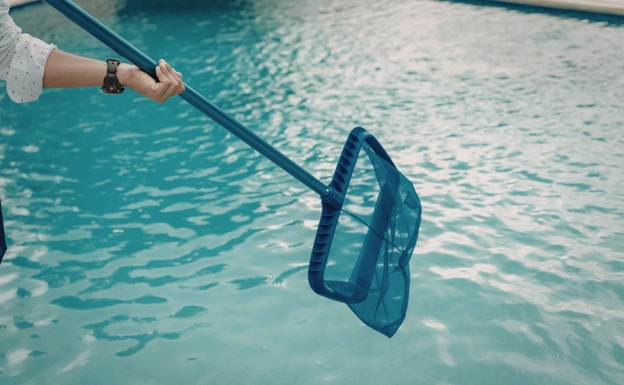
- Leaf net and a pool brush
- Vacuum head/hose or a robotic cleaner
- Filter cleaner (right type for your filter)
- Your usual chemicals (sanitizer, pH adjuster, alkalinity support, etc.)
- A small notebook or phone note for readings
Most pool issues start with, “I didn’t have time for a week,” and then the pool tries to make up its own rules.
Test the Water Often
In summer, more swimmers introduce oils and sunscreen, water changes faster, and the sun burns off sanitizer. Testing once a week is like checking your car’s oil once a season.
How to Test
- Take a sample elbow-deep, away from return jets
- Test around the same time of day when you can
- Write down the results before adding anything
- Make small adjustments, then circulate and retest
What to Test
- Sanitizer level (chlorine or your system’s sanitizer)
- pH
- Total alkalinity
- Stabilizer/CYA (this matters a lot in sunny conditions)
- Calcium hardness
- Salt level (if applicable)
How Often to Test
- 2–3 times per week in peak summer
- Always test after heavy use (pool party weekends), heat waves, windstorms, or rain
The best time to test is when the pool looks perfect, because that’s how it stays perfect.
Keep the Chemistry Balanced
Balanced water doesn’t just “look nicer”, it helps sanitizer work properly and protects expensive parts like heaters, pumps, seals, and your pool finish.
Adjust in this order:
- Total alkalinity
- pH
- Sanitizer
- Calcium hardness
- Stabilizer/CYA (and salt, if you have it)
This order matters because alkalinity and pH influence each other, and both impact how well sanitizer does its job.
Clean Smarter, Not Harder
Cleaning isn’t just cosmetic. Leaves, dust, pollen, and sunscreen residue all consume sanitizer and cloud the water. A few small cleaning habits keep chemistry stable.
Simple Summer Cleaning Routine
- Skim: daily or every other day
- Brush: 1–2 times per week
- Vacuum: weekly (or run a robot multiple times a week)
- Empty baskets: weekly (more if it’s windy or you have trees)
Don’t Skip These Spots
- Steps and shallow ledges
- Behind ladders and rails
- Waterline tile
If you only have time for one thing in a busy week, brush the steps and ledges.
Clean Your Filtration System
If your chemicals look reasonable but the pool is still dull or hazy, the filter is often the missing piece. In summer, filtration is working overtime.
How To Clean Your System
- Learn your clean filter pressure baseline
- When the pressure rises noticeably above baseline, clean/backwash according to your filter type
- Keep skimmer and pump baskets clean so water flow stays strong
Different systems have different cleaning methods, so follow the manufacturer guidance, but the principle is the same: a clean filter keeps the pool easier to maintain.
A dirty filter makes you use more chemicals and still feel like you’re behind.
Run Your Pool Long Enough to Keep Up with Summer
Summer usually needs more circulation time, especially during heat waves or weeks with heavy use.
How to Improve Circulation
- Angle return jets so water moves in a gentle circle toward the skimmer
- Make sure skimmer weir doors move freely
- Increase pump runtime during hot spells and after busy weekends
- Watch for “dead zones” where debris always collects
Circulation is one detail that experienced pool construction companies in Napa County tend to prioritize because strong circulation makes ownership simpler year after year.
Do a Weekly Equipment Check Up
You don’t need to take anything apart. Just look and listen.
What to Check Weekly
- Pump sound: anything new (whining, grinding, rattling)
- Leaks: drips around fittings, valves, heater connections
- Air bubbles: persistent bubbles under the pump lid can signal a suction-side issue
- Heater behavior: starts normally, no recurring error codes, holds temperature
- Automation/timers: schedules still make sense for summer
If it involves electrical or gas systems, keep it to basic observation and call a professional. It’s not worth risking damage, or safety.
How to Fix the Most Common Summer Pool Problems
If the Water Turns Cloudy
- Clean/backwash the filter
- Brush walls and steps thoroughly
- Run circulation longer than usual for a day
- Test sanitizer and pH, correct gently
- Retest after a few hours of circulation
Cloudiness is often a filtration and circulation issue first, chemistry issue second.
If Algae Keeps Returning
- Brush steps/ledges more often
- Confirm sanitizer is keeping up with heat and swimmer load
- Improve circulation in dead zones
- Make sure filtration is clean and runtime is adequate
A Summer Maintenance Schedule You Can Actually Stick To
Daily (or every other day)
- Quick skim
- Check water level
2–3 times per week
- Test sanitizer and pH
- Empty skimmer basket if needed
Weekly
- Brush walls + steps/ledges
- Vacuum or run robot
- Check filter pressure
- Quick equipment scan (leaks/noises/air bubbles)
Monthly
- Deeper filter clean
- Inspect/lubricate O-rings if appropriate
- Check salt cell for scale (salt pools)
- Revisit automation schedules as temperatures shift
This routine keeps your pool looking “guest-ready”.
Want a Summer Pool That Stays Effortlessly Clear?
If your pool is showing signs, it may be time for bigger improvements. Our team at Sonoma Pool & Spa is happy to talk through renovation or rebuild options, so you can make a confident decision and enjoy the season the way it’s meant to feel, easy.
For a free estimate, call Sonoma Pool & Spa at (707) 396-7526 or contact us online to learn more.

Owner / President, Sonoma Pool & Spa, Inc.
Owner of Sonoma Pool & Spa, located in Sebastopol.